EARS Plant Photosynthesis Meter
EARS Plant Photosynthesis Monitoring B.V. · Wageningen
Measure plant photosynthesis in under a second
The handheld miniPPM chlorophyll fluorescence meter gives researchers, growers and educators an instant, reliable reading of plant photosynthesis. Just press the button.

Since 1983
Researching plant fluorescence
< 1 second
Per photosynthesis measurement
3,000
Measurements on one battery charge
250 g
Light enough to carry all day
About EARS
Four decades of photosynthesis research, in your hand
EARS is a high-tech remote sensing company in Wageningen, specialised in remote and near sensing techniques.
Our mission
EARS-P2M carries out our near sensing activities, using the plant chlorophyll fluorescence signal to monitor photosynthesis. Since 1983 we have done extensive research on laser-induced fluorescence, and in the 1990s we developed and patented our own Plant Photosynthesis Meter (EARS-PPM): a handheld, modulated saturation pulse fluorometer.
Our vision
We develop applications for greenhouse climate control, irrigation management and reducing herbicide use in agriculture. Other measuring techniques, like high-resolution spectrometry, and applications such as optimising plant and algae growth, have our continuous attention.
Application range
The miniPPM is used in research, education and practice. It is ideal for teaching, and a unique tool for anyone who wants to know more about the health and growth of plants.
The instrument
About the miniPPM
The miniPPM is the third generation of our plant photosynthesis meter. New optics, electronics and an advanced measuring concept make it much smaller and lighter than earlier versions, without compromising on quality or accuracy.
It is simple to use: press the button and a photosynthesis measurement is complete within a second. Laboratory tests show that measurements are stable and reproducible.
- Long series of measurements without user interaction
- Stores measurements in memory with time and date
- Save to microSD card or download directly to a PC
- 3,000 measurements on a full battery
- Weighs only 250 grams
1-year warranty
Every miniPPM comes with a one-year warranty.
Worldwide shipping
Shipped from the Netherlands. Costs depend on your location.
Choose your model
Which miniPPM is right for you?
All four versions measure fluorescence and photosynthesis yield. Each step up adds more: data logging, light (PAR) measurement, PC control and automatic light curves.
Essentials
miniPPM-100
Measures fluorescence (F, Fm) and photosynthesis yield (Y) at any light level, with an LCD read-out.
Best for: education, quick checks and herbicide efficacy.
Adds data logging
miniPPM-150
Everything in the 100, plus long unattended measuring series, on-board storage and microSD read-out.
Best for: field studies and seedling screening.
Adds light & PC control
miniPPM-200
Everything in the 150, plus a PAR light sensor, photosynthesis rate in ambient light and USB PC control.
Best for: greenhouse light climate and irrigation management.
Most complete
miniPPM-300
Everything in the 200, plus measurements at pre-defined light levels and automatic light–photosynthesis curves.
Best for: finding the right screening level to prevent light damage.
Full comparison
Scroll sideways on a phone to see all four models.
| Feature | miniPPM-100 | miniPPM-150 | miniPPM-200 | miniPPM-300 |
|---|---|---|---|---|
| Measurements | ||||
| Fluorescence in ambient light (F) | ✓ | ✓ | ✓ | ✓ |
| Maximum fluorescence (Fm) | ✓ | ✓ | ✓ | ✓ |
| Photosynthesis yield (Y) | ✓ | ✓ | ✓ | ✓ |
| Photosynthetic Active Radiation (PAR) | ✓ | ✓ | ||
| Measurements at all light levels | ✓ | ✓ | ✓ | ✓ |
| Photosynthesis rate in ambient light (P) | ✓ | ✓ | ||
| Long unattended measuring series | ✓ | ✓ | ✓ | |
| Photosynthesis at pre-defined light levels | ✓ | |||
| Light - Photosynthesis curves | ✓ | |||
| User interface | ||||
| LCD display with various read-out options | ✓ | ✓ | ✓ | ✓ |
| Read out and storage on microSD card | ✓ | ✓ | ✓ | |
| On board control and storage | ✓ | ✓ | ✓ | |
| PC control (USB) and storage | ✓ | ✓ | ||
| Applications | ||||
| Herbicide efficacy / damage | ✓ | ✓ | ✓ | ✓ |
| Quality of plants, vegetables, fruit | ✓ | ✓ | ✓ | ✓ |
| Seedling screening for breeding | ✓ | ✓ | ✓ | ✓ |
| Plant photosynthesis yield monitoring | ✓ | ✓ | ✓ | ✓ |
| Plant photosynthesis rate monitoring | ✓ | ✓ | ||
| Steering of light climate in greenhouses | ✓ | ✓ | ||
| Irrigation management | ✓ | ✓ | ||
| Additional deliverables | ||||
| Protective case | ✓ | ✓ | ✓ | ✓ |
| USB Data Cable | ✓ | ✓ | ✓ | |
| USB Charger | ✓ | ✓ | ✓ | ✓ |
| 4 adapter set for different countries mains | ✓ | ✓ | ✓ | ✓ |
| 2 GB MicroSD Card | ✓ | ✓ | ||
| microSD to USB adapter | ✓ | ✓ | ✓ | |
| English / Dutch Manual | ✓ | ✓ | ✓ | ✓ |
| 1 Year Warranty | ✓ | ✓ | ✓ | ✓ |
| Optional items | ||||
| 12V fast charger / power supply | ✓ | ✓ | ✓ | ✓ |
| RS-232 communication port | ✓ | ✓ | ||
| RS-485 communication port | ✓ | ✓ | ||
| 433 or 915* MHz wireless remote PC connection | ✓ | ✓ | ||
| Tripod stand with gooseneck and 1/4" UNC adapter | ✓ | ✓ |
Applications
What you can measure with the PPM
From the lab to the greenhouse: three examples of how photosynthesis measurements answer practical questions.
Herbicide efficacy
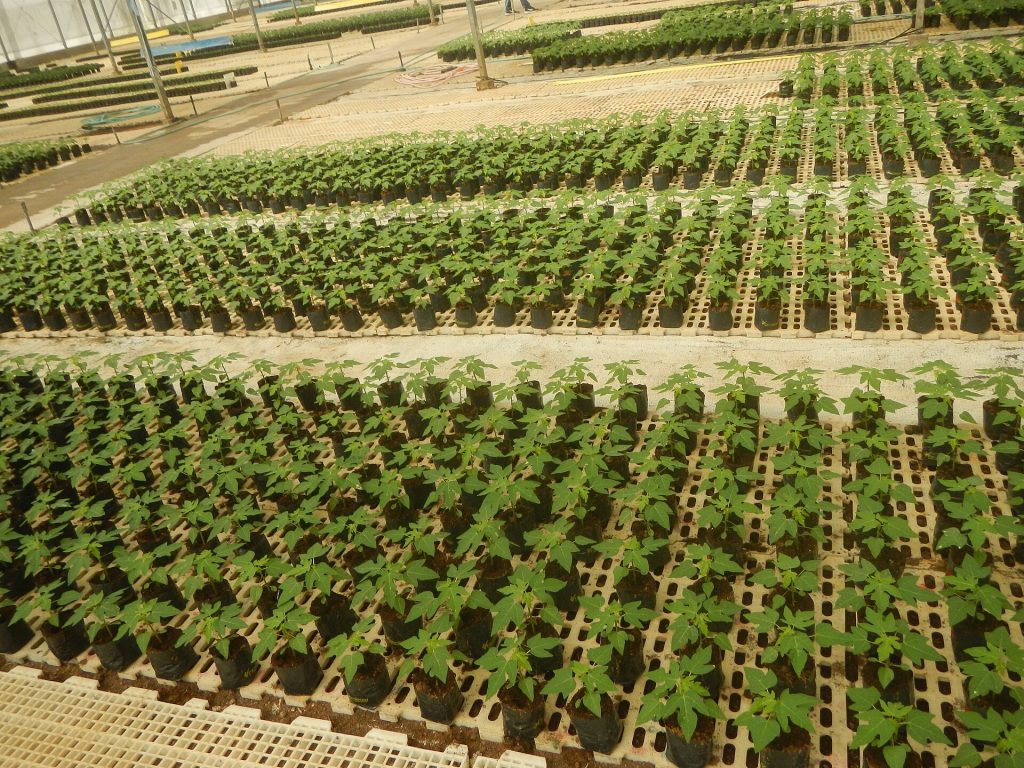
Many herbicides work by blocking photosynthesis. Because the PPM measures photosynthesis yield directly, it shows how strongly a treatment affects a plant. This lets you compare products, doses and timing objectively.
All miniPPM models support herbicide efficacy and damage measurements.
Genetically modified plants
Much research on the genetic modification of plants is dedicated to developing herbicide-resistant crops. Many herbicides are photosynthesis inhibitors that bind to essential protein complexes of the photosystems. Modifying these proteins can make plants resistant, but because nature already evolved very efficient photosystems (up to about 80% maximum photosynthesis), such modifications usually reduce the photosynthetic and growth capacity of the plant.
Resistant weed mutants also develop in the field under intensive herbicide use. Black nightshade (Solanum nigrum), for example, has a version that is not sensitive to atrazine. PPM measurements show that this mutant’s photosynthesis efficiency is notably lower. The effect of genetic modification on productivity has received little attention so far, and the PPM can be used to investigate it.
Preventing light damage
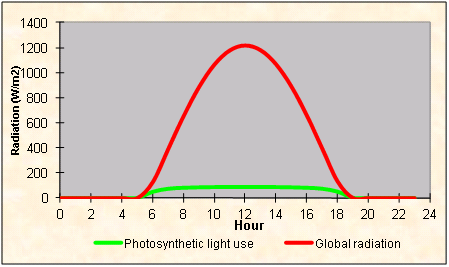
Too much light stresses plants and can damage them. At low light, photosynthesis is limited by the available light. As light increases, photosynthesis reaches a point where the energy for the reaction and the uptake of CO₂ are in balance. Above that, photosynthesis cannot increase and the excess light inhibits it and may “burn” the plant.
Growers use light screens, but the right moment to screen varies with species, variety, light adaptation after winter, water shortage and CO₂ levels. With the PPM, growers can measure the exact screening light level of their plants.
The miniPPM-300 is best suited for this: it automatically measures the light–photosynthesis curve of a plant species. In one example, optimum photosynthesis occurred at 780 µmol/m²s, a photosynthesis rate of about 190 µmol/m²s, corresponding to a dry matter production of 1.9 g/m²h. Because PAR levels in greenhouses can reach 1,700 µmol/m²s on sunny days, screening is essential. As a rule of thumb, screen when the photosynthesis yield measured with the PPM drops below 40%.
Not sure which model fits your work?
Tell us what you want to measure and we will help you choose the right miniPPM.
Contact
Get in touch
Want to discuss a project, request a quote or ask which model suits you? Send us a message and we will get back to you.